The concert night
Why Vienna still does this, every single night
Mozart lived and worked in Vienna for the last decade of his life, and Johann Strauss II — the "Waltz King" — was a Vienna institution a century later; between them they gave the city a musical identity it has never let go of. What's unusual is that Vienna didn't turn that history into a museum piece: it turned it into a nightly, living performance. Chamber orchestras in themed venues play programmes built almost entirely from Mozart and Strauss, most evenings of the year, aimed squarely at visitors who want to hear this music the way Vienna has always heard it — live, indoors, dressed for the occasion, in a room built for exactly this.
What the evening actually feels like
You arrive at a lit, ornate building, are shown to a seat among a mixed crowd of tourists and locals, and for around two hours a chamber orchestra — sometimes joined by a soprano and tenor for opera excerpts, sometimes with a couple in period dress performing a short waltz — works through a programme of overtures, arias and waltzes. It's less austere than a full philharmonic subscription concert and more theatrical: there's usually a compere, a little audience participation, and an interval with a drink. If you've never sat through a classical concert before, this is deliberately built to be the approachable version, not the intimidating one.
It's not the Vienna Philharmonic, and that's fine
It's worth being straightforward about what these concerts are. The Vienna Philharmonic and Vienna Symphony play their own separate, much harder-to-book subscription seasons, often in the very same halls. The nightly Mozart-and-Strauss concerts use different, smaller ensembles — highly professional working musicians, several of them current or former members of the city's major orchestras, but performing a shorter, crowd-pleasing programme rather than a full symphonic season. Sold honestly, that's exactly what makes them bookable on a few days' notice for a one-off visit, rather than a subscription you'd need to plan a year out.
Which concert & venue
Musikverein, Kursalon, Karlskirche or Schönbrunn?
"A Vienna Mozart concert" isn't one product — it's several different venues, each with its own history and its own kind of evening. None of them is objectively "better"; they suit different priorities.
The famous one
Musikverein — Golden Hall
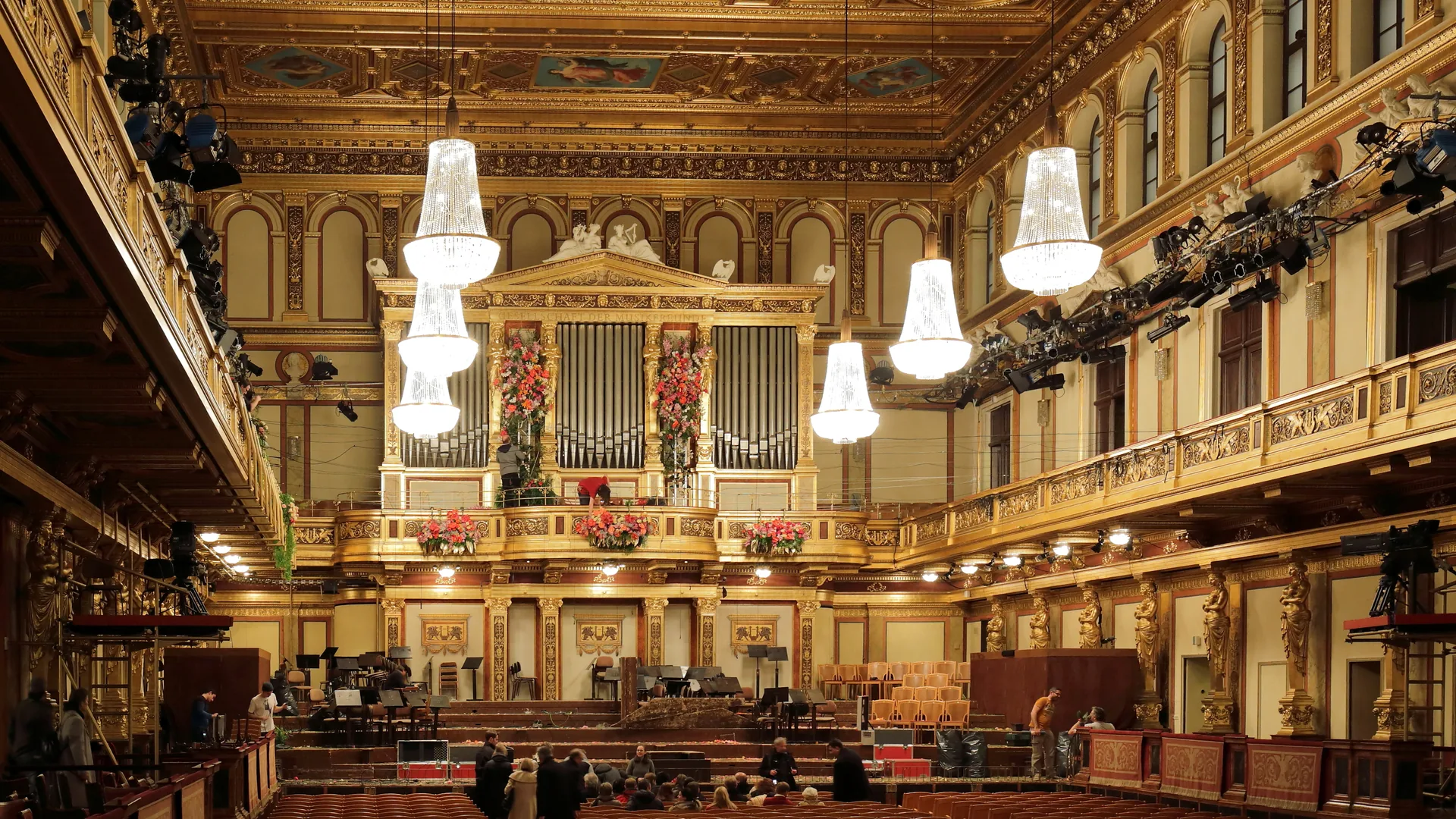
Opened in 1870 and designed by Theophil Hansen, the Musikverein's Golden Hall (Goldener Saal) is the room the Vienna Philharmonic uses for its televised New Year's Concert, and it's widely rated among the best-sounding concert halls anywhere. The nightly Mozart concert here — performed by the Vienna Mozart Orchestra in 18th-century costume — puts you in the same gilded, statue-lined hall on a night the Philharmonic isn't playing. It's the choice if you want the single most recognisable room in Viennese classical music, whatever's on the bill.
The Strauss connection
Kursalon Wien
Built in 1867 in the Stadtpark, the Kursalon is where Johann Strauss II himself once conducted, and it remains closely tied to his waltzes and operettas. Concerts here lean further into the Strauss side of the Mozart-and-Strauss pairing — expect more waltz and polka, sometimes a folk-dance interlude, and versions with dinner included. It's the pick if the Strauss half of the evening matters more to you than the Mozart half, or if you'd rather add a meal to the night.
The baroque church setting
Karlskirche
St. Charles's Church (Karlskirche), completed in 1737 to a design by Johann Bernhard Fischer von Erlach, is one of Vienna's grandest baroque buildings, and it periodically hosts choral and orchestral concerts — including Mozart's Requiem — beneath its enormous dome. The setting is more solemn than the hotel-ballroom feel of a themed concert, and the acoustics and visuals of a church interior are genuinely different from a purpose-built concert hall. Worth choosing if you want the music paired with the building itself as the main event, rather than costume and theatre.
The imperial-palace evening
Schönbrunn Palace — Orangery
Schönbrunn has its own Mozart connection: as a six-year-old, Mozart reportedly performed for Empress Maria Theresa at the palace in 1762. Concerts staged in the palace's Orangery lean on that imperial setting rather than any single hall's acoustic reputation — you're paying partly for the palace itself, often as part of an evening that includes a palace tour or dinner. Choose this if seeing Schönbrunn is already on your list and you'd rather combine it with the concert than visit twice.
What you'll hear
The Mozart & Strauss programme
What's actually on the bill
Programmes vary by night and venue, but the shape is consistent: overtures and arias from Mozart's best-known operas (The Magic Flute, The Marriage of Figaro, Don Giovanni), a handful of his orchestral and chamber pieces, and a run of Johann Strauss II waltzes and polkas — The Blue Danube is a near-certain inclusion somewhere in the evening. Many concerts add a soprano and tenor for one or two operatic numbers, and some include a costumed couple dancing a short waltz.
Full orchestra or chamber ensemble?
It's worth checking this before you book, because it changes the sound and the price. A full-strength orchestra fills a room like the Golden Hall with a much bigger sound; a smaller chamber ensemble (roughly eight to twelve players) is more common at the themed Mozart-and-Strauss concerts and is intimate rather than symphonic. Neither is "better" — a chamber ensemble suits the lighter, more theatrical programme these evenings usually run, while a full orchestra is closer to what you'd hear at a Philharmonic or Symphony subscription concert.
How long, and is there an interval?
Most evenings run around two hours including one interval, which is typically when a drink is served and is also the natural point to step out if the programme isn't for you. Some venues sell shorter one-act formats or add a pre-concert dinner that extends the whole evening to three hours or more — the specific running time and interval arrangement are set out on each listing.
Ways to spend a Vienna concert evening
Find a Mozart & Strauss concert for your dates
Every option below is bookable through GetYourGuide, with live availability and the final price shown in your own currency before you pay.
Dress code & etiquette
Dress code & etiquette
You do not need black tie
This is the single most common worry, and the honest answer is: smart-casual is genuinely fine at every one of these venues. A jacket for men and a nice dress or smart separates for women will fit in comfortably; jeans and a clean shirt won't get you turned away either, though you'll notice most of the room has made a bit of an effort. Save the tuxedo for the actual Vienna Opera Ball — these nightly concerts are dressed a notch above sightseeing clothes, not black tie.
What to actually avoid
Shorts, flip-flops and sportswear stand out more than anything else, simply because almost nobody else in the hall is wearing them. Beyond that there's no enforced code — no one will check your outfit at the door. If in doubt, dress the way you would for a nice dinner out, and you'll be dressed correctly for a Vienna concert evening.
During the performance
Phones on silent and away, photography generally discouraged once the music starts (a few venues allow a quick photo before the first piece), and applause customarily comes at the end of a full piece rather than between movements — if you're unsure when to clap, a half-beat behind the room is the safe move. Latecomers are usually held at the door until a natural break, so build in a buffer to arrive on time.
Arriving & timing
Arriving & timing
When concerts start, and when to arrive
Most Mozart-and-Strauss concerts start in the early evening, commonly somewhere between 7:30 and 8:30pm, with doors and box office opening roughly 30–45 minutes beforehand for will-call and last-minute seats. Aim to be at the venue at least 20–30 minutes before curtain — later than that, and you're competing with the whole audience for the cloakroom and your seat, or risk being held outside until the interval.
Getting there
The Musikverein and Karlskirche both sit just off the Ringstrasse near Karlsplatz, an easy walk or short U-Bahn ride from most central Vienna hotels; the Kursalon is in the Stadtpark, a similarly short walk from the same area. Schönbrunn is the outlier — it's a separate palace complex a U-Bahn ride from the centre, so build extra travel time (and, if you're combining it with a palace tour, extra time before the concert) into that evening specifically.
Tickets, seating and the interval
Bring your booking confirmation (printed or on your phone) — most venues scan a QR code or exchange it for a paper ticket at the door. Seating is usually allocated by price tier (stalls vs gallery, or numbered rows), so where you sit is generally fixed by what you booked rather than first-come-first-served. The interval is the point to collect a pre-ordered drink, use the cloakroom, or simply stretch your legs before the second half.
Guides
Planning your Vienna concert evening
Karlsplatz, the Stadtpark and one palace outlier
Getting to Vienna's Mozart Concert Halls by U-Bahn
Most of Vienna's Mozart-and-Strauss venues sit within a few minutes of Karlsplatz or the Stadtpark. How to reach each hall, when to arrive, and which evening needs extra travel time.
Read more →One evening, four very different rooms
Musikverein, Kursalon or Karlskirche: Choosing Your Night
A costumed orchestra in the Golden Hall, waltzes beside the Stadtpark, or period instruments under a baroque dome — how to match the venue and format to the evening you actually want.
Read more →Timing, seasons and the fine print
Planning a Vienna Concert Evening: Timing & Seasons
When concerts start and finish, how the calendar shifts across the year, what to wear, and the small print — tickets, seating tiers and intervals — that shapes the night.
Read more →THE PROGRAMME, EXPLAINED
The Music Behind a Vienna Mozart & Strauss Concert
Eine kleine Nachtmusik, an aria from The Magic Flute, the Blue Danube and the Radetzky March — what's on the bill, and why this mix of pieces still works.
Read more →WHY VIENNA, WHY MUSIC
Vienna: The City Mozart and Strauss Both Called Home
Mozart arrived in 1781, Strauss's waltzes ruled the ballrooms a century later — how one city produced, and still performs, two centuries of classical music.
Read more →BEYOND THE CONCERT HALL
What Else to See on a Vienna Mozart Concert Trip
Mozart's only surviving Vienna home, the State Opera, a hands-on sound museum and the coffeehouse tradition — how to build a fuller day around your concert.
Read more →GEO/FAQ
Questions people ask before booking
Do I need to know classical music to enjoy a Vienna Mozart concert?
No. These concerts are deliberately built for a general audience rather than seasoned concertgoers — expect a compere who introduces each piece in plain terms, a programme built from Mozart and Strauss's most recognisable melodies rather than obscure works, and a relaxed, theatrical atmosphere rather than a formal recital. Plenty of people attend having never been to a classical concert before, and it's designed to work for exactly that.
What's the difference between the Musikverein, Kursalon and Karlskirche concerts?
The Musikverein's Golden Hall is the famous room the Vienna Philharmonic uses for its New Year's Concert — the pick if the hall itself is the draw. The Kursalon leans further into Johann Strauss II, who conducted there himself, with more waltz and polka and dinner options. Karlskirche is a baroque church that hosts occasional choral and orchestral concerts (including Mozart's Requiem) under its dome — more solemn, less costume-and-theatre. Choose based on which setting and programme balance you want.
Is a Schönbrunn Palace concert worth it over the others?
It depends what you're optimising for. A Schönbrunn Orangery concert trades on the palace's imperial setting and Mozart's own recorded 1762 performance there for Empress Maria Theresa, and it's often bundled with a palace tour or dinner. If seeing Schönbrunn is already on your Vienna list, combining it with the concert can save a separate trip; if you specifically want the Musikverein's acoustics or the Strauss connection, one of the central venues is the better fit.
Do I need to dress up? Is it black tie?
No — smart-casual is genuinely fine at every one of these concerts. A jacket or a nice dress fits right in; jeans and a clean shirt won't get you turned away either. The one thing to actually avoid is shorts, flip-flops or sportswear, simply because you'll be the only one wearing them. Black tie is for the Vienna Opera Ball, not these nightly concerts.
How long does the concert last, and is there an interval?
Most Mozart-and-Strauss concerts run around two hours, including one interval — typically the point where a drink is served and you can step out briefly. Some venues offer shorter formats or dinner-and-concert packages that extend the evening to three hours or more; the exact running time is set out on each specific listing.
What will I actually hear — is it really Mozart AND Strauss?
Yes, on most programmes. Expect overtures and arias from Mozart's best-known operas (The Magic Flute, Figaro, Don Giovanni), some of his instrumental works, and a run of Johann Strauss II waltzes and polkas — The Blue Danube shows up on the large majority of these programmes somewhere. Many concerts also feature a soprano and tenor for a couple of operatic numbers, and some add a costumed couple dancing a short waltz.
How far ahead should I book?
These concerts run nightly year-round and rarely sell out completely, so a few days to two weeks ahead is usually plenty outside peak periods. The best-value seats — central stalls and the front rows of the gallery — go first, and dates around New Year, the January–February ball season and midsummer weekends fill faster than the rest of the year. Booking same-day is possible but limits you to whatever's left, sometimes restricted-view seats.
What time do concerts start, and when should I arrive?
Most start in the early evening, commonly between 7:30 and 8:30pm, with the box office opening 30–45 minutes beforehand. Plan to arrive at least 20–30 minutes before curtain to collect tickets, use the cloakroom and find your seat without rushing — latecomers are typically held at the door until the interval.
Is this the same as a Vienna Philharmonic concert?
No, and it's worth being clear about that. The Vienna Philharmonic and Vienna Symphony run their own subscription seasons, often in these same buildings, and those tickets are considerably harder to get on short notice. The nightly Mozart-and-Strauss concerts use separate, smaller ensembles — professional musicians, some with ties to the major orchestras, playing a shorter, more accessible programme designed for visitors booking a one-off evening rather than a season subscription.
Can I take photos during the concert?
Generally, no, once the performance begins — most venues ask you to put phones away and don't allow photography or video during the pieces themselves, partly out of courtesy to other guests and performers. A quick photo of the hall before the concert starts, or during the interval, is usually fine; check the specific venue's house rules if you're unsure.
How do I get to the venue, and is parking or public transport easier?
The Musikverein and Karlskirche are both just off the Ringstrasse near Karlsplatz, a short walk or one U-Bahn stop from most central hotels, and public transport is by far the simpler option in central Vienna's traffic and limited parking. The Kursalon in the Stadtpark is similarly central. Schönbrunn is a separate palace complex a U-Bahn ride out from the centre, so allow extra travel time for that specific evening.
Is the price shown final, and how does booking work?
You book through GetYourGuide, which shows the final price in your own currency before you pay and states the cancellation policy for your specific date up front — the price you see is the price you pay, with no hidden fees added at checkout. We're an independent guide to the concert scene, not the orchestra, venue or ticket office; the booking itself is handled by GetYourGuide's secure checkout.